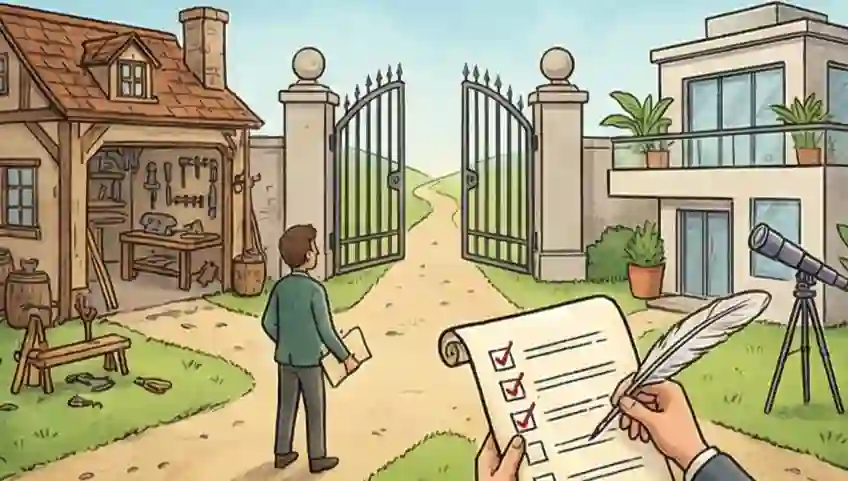
The Three Main "Rules to Follow"
-
01
Focus on Solving Problems, Not Just Doing the Job Don't just ask for a job; act like a hired expert ready to fix a problem. When you show up with a clear plan for your first 90 days, you change who has the power. You stop looking like something the company has to pay for and start looking like a worthwhile investment that will quickly earn its keep.
-
02
Find Out What They Aren't Saying The most important details are never written down. You need to figure out the company's secret problems and what the hiring manager personally wants to achieve. If you can speak their private language and point out their hidden troubles, you become the only person who seems to truly get what they need.
-
03
Make Them Feel Safe About Hiring You When hiring for big jobs, companies worry more about making a bad choice than finding a perfect one. To keep your job safe long-term, you must bring up your weak points yourself before they ask. When you back this up with proof of past wins (like saving money or improving operations), you go from being a risky choice to a safe one.
Why Simple Preparation Isn't Enough
Most pre-interview checklists focus on the easy stuff: picking the right clothes, printing your resume, and practicing answers to basic questions. For important interviews, this is a weak strategy. It treats the interview like a simple test to pass, not a business deal to close.
When you only focus on surface-level tasks, you tell the company you might be a risky hire. For any business, hiring someone is a major financial commitment. A 2024 CareerBuilder study found that 74% of employers have made a bad hire, with the average cost reaching $17,000 per mistake. They aren't just looking for someone who fits in; they need someone they are sure won't fail.
To succeed, you must fix the Information Imbalance that exists when you interview. The company knows its internal problems, and you know your skills, but neither side knows the full picture yet.
Winning means closing this gap. This requires going beyond a simple checklist and using a Careful Checking Process to find out the hidden problems and real needs of the business. The steps below move your preparation from just hoping for the best to using a real plan, making sure you show up as the exact fix for the company's biggest issues. Once the strategy is clear, our night-before interview guide helps you handle the logistics so your mind stays sharp on the day.
What Is a Pre-Interview Checklist?
A pre-interview checklist is a structured set of tasks you complete before a job interview, covering company research, personal positioning, logistics, and mindset prep. The goal isn't to rehearse scripted answers. It's to understand the business problem you're being hired to solve and show up with a plan to solve it.
The standard checklist stops at logistics: print your resume, lay out your clothes, review common answers. The strategic version starts earlier and goes deeper. It maps the company's real problems, identifies what the hiring manager personally needs to succeed, and positions you as the obvious fix. That shift (from prepared candidate to hired consultant) is what separates offers from polite rejections.
Checking Your Interview Performance
Use this chart to quickly spot the common mistakes in how you prepare for interviews. For each area, check where you currently are in terms of what you see (Symptom), why it's happening (Root Cause), and what you need to focus on (Strategic Goal).
Worrying about small details like clothes, printing papers, and having scripted answers ready.
Seeing the interview as a social event or a simple school test rather than a business negotiation.
The Admin Helper: You look like someone who can follow orders but not lead or solve complex problems.
Shift your preparation from "presentation" to "investigation" of the company's pain points.
Listing many past successes without explaining why they matter to the company's current situation.
Treating your skills like a general commodity instead of a specific solution for a specific business crisis.
The Resume Star: You look impressive on paper, but the interviewer isn't sure how you help them today.
Translate your past wins into a custom business case that targets their specific "Trouble Spot."
Asking deep questions about company issues and speaking as if the job has already started.
Using pre-interview research to bridge the knowledge gap and act as a consultant rather than a candidate.
The Business Peer: You are viewed as a high-value partner who understands the bottom line.
Maintain this "Expert" stance to move from "Asking for a Job" to "Closing a Deal."
7 Steps to Win the Deal
As an expert career advisor, I suggest you stop just "preparing for interviews" and start using a Careful Checking Plan. To get a senior job, you must stop trying to get hired and start acting like a consultant who has the answer.
Look into recent company news, financial reports, or industry changes to find the problems they haven't mentioned in the job ad. This matters more than most candidates realize: 47% of recruiters reject candidates outright for showing no knowledge of the company, according to research by High5Test (2024). Understanding the full picture (the Information Imbalance) lets you show how your skills fix their hidden issues. Our guide on researching a company beyond its homepage walks through exactly where to look.
Make a short plan showing the exact results you promise in your first three months. This uses Signaling Theory to prove you are a leader who can produce results right away and won't need constant management.
Decide the top three reasons a smart hiring manager might hesitate to hire you—maybe a skill you lack or a short time spent at a previous job. By pointing these out first, you calm their fear of making a wrong choice (Loss Aversion), which is usually stronger than their excitement about you.
Change every big success on your resume into a clear number, like how much money you made or how much time you saved. This makes the interviewer think about what the company loses every day the job is open (the Opportunity Cost of not hiring you).
Look into your interviewer's career path and recent work to see what makes them look good to their boss. This helps you find the spot where your goals match theirs perfectly (the ZOPA), lining you up with what they personally need to succeed.
Tell stories about the tough projects you handled and the high-level results you achieved before. This uses Anchoring to set a high mental price for your skills, so the company sees you as a valuable asset, not just a cost to cut down.
Talk to people in your contacts who work there to learn the real, unspoken rules of the team you are joining. This gives you Social Proof, letting you speak their internal language and show that you are already an "insider" who won't cause trouble for the team.
Cruit Tools for Checking Before You Interview
For Seeing Potential Failure
Job Analysis ToolFinds reasons why you might not be chosen by comparing your resume to the job ad, giving you a list of "Fixes" for any skill gaps.
For Getting Insider Info
Networking ToolCreates custom messages using AI to help you ask company insiders about unwritten rules and secret pain points.
For Showing Your Value
Interview Prep ToolTurns your work history into stories with measurable results (STAR method) and helps you set a high value for your expertise.
Common Questions Answered
How do you find a company’s hidden problems before an interview?
Ask about their future goals, not their past mistakes. Instead of probing what the company is doing wrong, ask what’s blocking them from reaching their goals next year.
Try: "As the team plans ahead, what’s the biggest thing holding you back from reaching your goals?" This focuses on return on investment and lets them share challenges without feeling criticized. You aren’t hunting for flaws. You’re finding the specific business problem you were hired to solve.
How do you prove you’re a safe hire when switching industries?
Risk comes from the unknown. Without direct experience in a new industry, the company fears you won’t understand their environment. Focus on proof of results rather than past job titles.
Show how the problems you solved before are the same ones they face now. A reliable track record shifts the conversation from your past industry to your ability to deliver outcomes. Candidates who frame their experience this way become safe hires because they’ve already proven they handle tough situations.
What do you do when an interviewer asks generic questions?
Generic questions like "What’s your biggest weakness?" often come from interviewers who haven’t fully prepared. Redirect using the Bridge Technique: give a quick, honest answer, then connect it to a business need.
For example: "My weakness used to be over-indexing on details, but I learned that in fast-moving roles, speed matters as much as precision. That brings me to a question: how does your team currently balance moving fast with keeping quality high?" This shifts focus from your personal performance to what the company actually needs.
How long does interview preparation take?
For competitive roles, plan on 3 to 5 hours of focused prep. Spend the first one to two hours researching the company and the role, including recent news and the interviewer’s background.
Use the next hour to prepare specific stories and results using the STAR format. Reserve 30 to 60 minutes to rehearse out loud. For senior positions, add time to build a 30-60-90 day plan you can reference naturally in the conversation.
What should you research about a company before an interview?
Go beyond the homepage. Read recent press releases and news coverage, look at earnings calls or annual reports if available, and search for recent leadership changes or product launches.
Check Glassdoor for patterns in employee feedback, and look up your interviewer on LinkedIn to understand their career path and recent projects. The goal is to spot priorities and problems that don’t appear in the job posting, then speak to those directly. Our guide on researching a company beyond its homepage covers exactly where to look.
Focus on what matters.
Shifting your thinking from "getting ready" to "running a strategy" changes the entire feeling of the interview. Stop treating the meeting like a test. Start treating it like a business deal. Candidates who reduce risk and understand the full situation walk in as the company's most secure investment. Make these steps a habit and every interview stops feeling like a job application. It becomes a deal you're closing.
Check Our Tools